
What Is Somatic Psychology? Part 1: Pierre Janet
Ann Matney | June 16, 2026
Somatic therapies are becoming easier to find, but the body has long been treated as secondary to the mind in the world of psychology.
You may have heard that somatic approaches can be especially helpful for trauma. That is true—and in many ways, the connection between trauma and the body has been present since the earliest foundations of psychotherapy.
I am often the first point of contact for potential new clients at our clinic, and many people tell me they are looking for something beyond talk therapy because talk therapy has not created the change they hoped for. They describe being able to talk about their trauma but also being able to talk their way around it, in ways that feel familiar and safe but do not result in trauma resolution.
To be clear—a skilled therapist working within a traditional talk therapy model will not simply allow clients to stay in familiar loops of explanation or analysis. Good therapy, whether somatic or talk-based, will involve some form of gentle confrontation to help clients notice what they are avoiding, move toward what feels difficult, and create change at a pace their system can actually tolerate.
In this series of blog posts, I want to explore the history and origins of somatic psychology—not exhaustively, but through key figures, ideas, and personal favorites that have shaped my own understanding. My hope is to help readers navigate the crowded world of psychotherapeutic approaches, with a special focus on somatic work, and to help you think about your own healing path in a more informed, empowered, and liberating way.
Why Somatic Psychology? A Purpose and Overview of This Series
It is important to remember that somatic psychology holds both soma and psyche: body and mind, body and soul. It is not a rejection of the psyche, but a reuniting of what has too often been separated. This is the approach I advocate. When we have access to the body and its often subconscious-role, much therapeutic change may result.
However, I am not exempt from wanting to choose a philosophical worldview for how all of this works—I love the psyche too. I love theory of mind and philosophy. So, toward the end of this series of posts, I hope to lightly address the question of the ontology (what is real) of somatic psychology as well. We are fortunate to have psychology as a field distinct from philosophy since Sigmund Freud, and throughout this recent history, we can examine how the body has been trying to find its way back into our understanding. Psyche alone remains incomplete, halved and questioning.
On this tour, I hope to visit some of my favorite thinkers and practitioners. I will use their contributions to trace a selective history of somatic psychology from Freud to the present, including Pierre Janet, a contemporary of Freud who studied trauma and dissociation as deeply embodied phenomena; Carl G. Jung, not a somatic psychologist, but a depth psychologist whose work left the door open for later somatic understandings; Wilhelm Reich and Ida Rolf, whom I will discuss together because of the overlap I see in their body-oriented approaches; Hubert Godard and other Rolf Movement practitioners and theorists, whose work brought perception, orientation, gravity, gesture, and coordination into the body-oriented lineage of structural integration; Eugene Gendlin, a philosopher at the University of Chicago whose work helped illuminate the importance of the client’s ability to attend to the “felt sense,” later developed into the practice of Focusing; Peter Levine, the developer of Somatic Experiencing, whose therapeutic work was influenced by body-oriented and felt-sense traditions; Pat Ogden, the developer of Sensorimotor Psychotherapy, who helped bring attachment, trauma, and body-based processing into a structured clinical model; Francine Shapiro, the developer of Eye Movement Desensitization and Reprocessing (EMDR); and Betty Martin and Harry Faddis, two educators who brought somatic psychology into the relational realm through consent-based touch theories. Each of these thinkers has made important contributions to a fuller understanding of human suffering, healing, and relationships.
Pierre Janet (1859–1947): Trauma, Dissociation, and the Foundations of Somatic Psychology
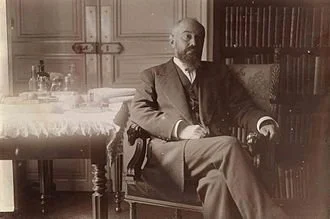
Pierre Janet (1859–1947). Photograph by Paul François Arnold Cardon (Dornac).
Let’s start with Pierre Janet (1859–1947). While Freud was developing psychoanalysis in Vienna, Janet was working in Paris with patients whose symptoms were often understood at the time as hysteria, dissociation, traumatic memory, and psychological shock. Long before the modern diagnosis of PTSD existed, Janet was studying how overwhelming experiences could become split off from ordinary consciousness and return through the body, emotions, images, and behavior.
Freud and Janet ended up tracing different dimensions of human suffering: Freud focused on intrapsychic conflict, while Janet emphasized dissociation and traumatic memory. Looking back, we could say that Freud “won,” at least institutionally. Freudian psychoanalysis remained highly influential through the 1950s, and the early Diagnostic and Statistical Manuals—DSM-I and DSM-II—were largely shaped by psychoanalytic categories and assumptions.
Freud tended to understand subconscious material as forbidden wishes, impulses, and conflicts that needed to be brought into awareness and mediated by the ego, while Janet was more interested in how overwhelming experience could become dissociated from ordinary consciousness and continue to express itself through the body, emotions, sensations, and behavior.
Janet was not practicing “somatic therapy” in the modern sense, but his work anticipated many ideas that later became central to somatic trauma treatment.
One of Janet’s most important treatment innovations—one that continues to influence trauma therapy and somatic psychology today—is the idea of a phased approach to trauma. Janet understood that trauma could not simply be confronted all at once. Treatment needed to begin with stabilization, then move toward processing traumatic material, and finally toward integration. In simple terms: stabilize first, process second, integrate third.
Janet also had the early insight that trauma is an overwhelming experience that can result in dissociation and incomplete integration. What cannot be fully experienced, remembered, or metabolized at the time may continue to live on through the body, emotions, sensations, images, behaviors, and symptoms. Today, we might understand some of this through the language of procedural memory: old, unprocessed experiences that haunt the body in a disorganized way as implicit patterns of sensation, movement, emotion, and response.
Janet recognized dissociation as a primary response to overwhelming experience. His study of “fixed ideas” and automatisms in traumatized people helped shape the way later trauma therapists would understand traumatic repetition—not as thought alone, but as something that can return through sensation, movement, affect, perception, and behavior. Trauma is not just a story. It can remain cut off from ordinary conscious awareness and be reenacted through bodily states, emotional responses, and patterned sequences of action.
This is one reason somatic psychology is so well suited to trauma work. By tracking nervous system states, body sensations, impulses, movements, and procedural patterns as they emerge in the session, somatic therapy can help clients work with trauma at the level where it continues to live—not only in narrative memory, but in the procedural memory, including the body’s learned patterns of protection and response.
Pierre Janet is the underground ancestor for this tour of somatic psychology. His work on dissociation, traumatic memory, automatisms, and phased treatment echoes through many of the approaches that followed, even when he is not explicitly named. We can hear Janet in later trauma theories that emphasize stabilization before processing, in somatic approaches that track how the past returns through sensation and movement, in EMDR’s attention to unprocessed memory, in Sensorimotor Psychotherapy’s focus on procedural patterns, and in Somatic Experiencing’s attention to incomplete defensive responses. Janet reminds us that trauma is not only an overwhelming event we remember but also something that can remain organized in the body, outside ordinary awareness, and waiting to be integrated.
Looking Ahead: Jung, Reich, and Rolf
Next stops in this series of blogs will include: Carl Jung, Wilhelm Reich, and Ida Rolf. Jung opened symbolic and imaginary doors that made room for more expansive understandings of psyche. Reich brought the body directly into the treatment room through his attention to muscular holding and character armoring. Rolf, working outside psychotherapy but deeply relevant to the history of somatic psychology, developed a body-centered approach to structure, gravity, and human organization. Together, they help us follow the next movement of this history, that results eventually (today) in the slow return of the body to the center of psychological healing.